June 23, 2026
My Dear Watson, You Are Not Lost. You Are Leaking!
Why modern exhaustion is often not tiredness, but attention loss...
READ ARTICLE →
From the 6:03 AM phone grab to the 11:47 PM “just one reel” tragedy!
Meet Ananya!
“Tomorrow,” said Ananya, placing her phone beside the pillow with the
seriousness of a freedom fighter placing a secret letter under a stone, “I am
going to change my life!”
Her husband, who had heard this announcement on several spiritually significant Sundays,
asked from the other side of the bed, “From tomorrow, or from Monday?”
“Tomorrow,” Ananya said with dignity. “I will wake up early. I will not touch the phone. I will drink
warm water. I may even stretch.”
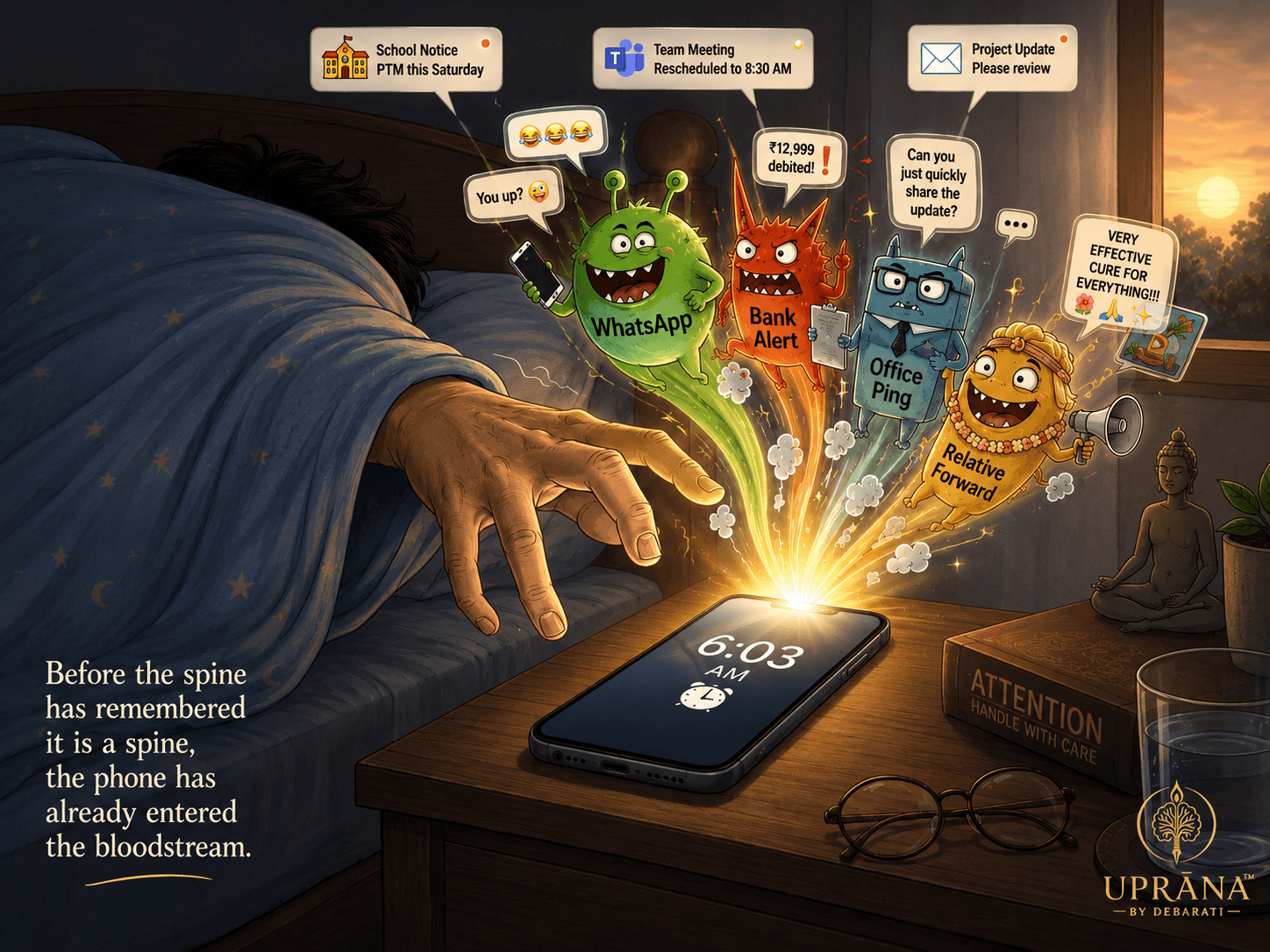
The phone lay between them, glowing faintly, like a villain pretending to sleep.
At 6:03 AM, the alarm rang.
Ananya opened one eye.
The soul woke up and made promises. Today will be different. Today I shall be calm, focused,
hydrated, disciplined, graceful, and possibly impossible to manipulate by processed
carbohydrates.
By 6:07 AM, the phone had been unlocked.
By 6:12 AM, three people had entered her mind without permission. One office message. One
school notice. One relative forwarding something called “NASA CONFIRMED ANCIENT
TURMERIC FREQUENCY,” written in a font that itself should be investigated.
By 6:20 AM, Ananya was technically awake, but her attention had already been distributed
among twelve stakeholders, none of whom were invited to breakfast.
This is how most modern days begin.
Not with intention.
With leakage.
In the first Uprāna Library article, we introduced the central diagnosis: you are not always lost,
lazy, weak, or unmotivated. Often, you are leaking. Your inner force escapes through tiny,
ordinary, socially accepted cracks before it can become clear action.
Now comes the practical question.
Where exactly do we leak?
Not in theory. Not in a Himalayan cave. Not in a beautifully lit wellness studio where everyone
drinks herbal tea and says “alignment” softly. Where do we leak in a normal day?
In the kitchen. In the inbox. In the school WhatsApp group. In the office call. In the family
argument. In the supermarket queue. In the bed at 11:47 PM when the thumb whispers, “Just
one reel.”
Uprāna identifies seven common Attention Leaks in an ordinary day.
You may not have all seven.
You may have three.
You may have five.
You may have all seven and deserve both compassion and a chair.
Let us investigate.
And for this investigation, we will follow Ananya.
Ananya is not irresponsible. She is not shallow. She is not weak. She is intelligent, loving, busy,
mildly dramatic in private, and dangerously optimistic about “starting fresh tomorrow.”
In other words, she is most of us.
1. The Morning Phone Leak
The Morning Phone Leak is the royal leak. The emperor of leaks. The one that arrives before
brushing, before bathing, before prayer, before tea, before the spine has received official
confirmation that the day has begun.
It usually begins innocently.
“I will just check the time,” Ananya whispers to herself.
This is the oldest lie in smartphone civilization.
Nobody checks only the time. The phone shows the time in the same way a sweet shop shows
the price of one sandesh. Technically yes, but look at everything else.
Ananya checks the time. Then the lock screen shows one message. The message leads to the
app. The app leads to a reply. The reply leads to another message. Suddenly she is reading a
debate about whether the class picnic should include mango juice or orange juice. She does not
even care about juice. But now her nervous system has formed an opinion.
Her son walks in and says, “Ma, where is my sock?”
Ananya looks up like a woman returning from a foreign war.
“What sock?”
“The blue one.”
“Why only one sock exists in this house is a philosophical problem,” she says.
By the time she sits with tea, her first attention has already been donated to the world.
In Uprāna, the first attention of the day matters deeply. Not because the morning must become
a sacred performance with imported candles and suspiciously expensive incense, but because
the first input often sets the tone of the system. If the mind begins with noise, the body begins
arranging itself around reaction.
This is why the Morning Phone Leak is not small.
It teaches the system one dangerous lesson:
The world enters before I arrive.
The brain is highly sensitive to cues. A morning cue can become a habit loop: wake, reach,
check, react, repeat. Over time, the hand becomes faster than intention. The thumb becomes
the family priest of the algorithm.
Ananya says, “I do not know why I feel scattered.”
Uprāna replies, “Because your morning was colonised before independence.”
Uprāna Note: This is an Attention Leak. The day begins before the person consciously enters
it. The deeper work is not merely “do not use the phone,” because advice without system-
training usually collapses by Wednesday. The deeper work is learning how to reclaim the first
attention before the world occupies it.
2. The Half-Reply Leak
At 8:15 AM, while Ananya is packing tiffin, finding the missing sock, and emotionally negotiating
with the pressure cooker, her phone vibrates.
A colleague has written:
“Need to discuss.”
Ananya freezes.
Her husband asks, “What happened?”
“Nothing,” she says, in the tone used by people to announce that something has definitely
happened.
These three words, “Need to discuss,” should be regulated by international law.
Immediately the mind opens a courtroom. What happened? Why “discuss”? Why not “talk”?
Why not “call”? Why no emoji? Is this professional? Personal? Emotional? Legal? Existential?
You type: “Yes, sure.”
Delete.
Type: “Yes?”
Delete.
Type: “Of course, tell me.”
Delete.
Type nothing.
Then you leave the message unanswered for twenty-seven minutes, during which you do not do
anything else properly either. The reply has not been sent, but it has already consumed a
portion of your life.
This is what Uprāna calls a Response Leak.
A Response Leak happens when the energy of communication is spent before communication
actually happens. Modern people are constantly half-replying. Not only to messages, but to life.
We mentally reply to emails while bathing. We compose savage responses while cooking. We
prepare diplomatic answers to imaginary criticism while travelling. We draft apologies we do not
owe and accusations we will never send.
The message sits quietly in the phone.
The nervous system does not.
It runs, edits, predicts, defends, attacks, softens, sharpens, reconsiders, and finally sends
“Okay.”
A whole Mahabharata for one “Okay.”
From a scientific point of view, this is not mysterious. The brain uses energy to predict
outcomes, manage social risk, and regulate emotion. Anticipatory stress can be more
exhausting than the actual reply. The mind begins living inside a possible conversation before
the conversation has even happened.
This is why one unread message can sit in the mind like a small unpaid tenant.
Rent-free.
Fully furnished.
Emotionally noisy.
Uprāna Note: This is a Response Leak. The energy of speech escapes before speech
becomes clear. The deeper Uprāna work is not simply “reply faster” or “ignore people.” It is
learning to keep the nervous system from becoming the typist.
Alt Text: A person staring at one message while fourteen ghost drafts float around their head:
“Sure,” “Yes?” “Of course,” “What do you mean?” “Can we talk about what?” and finally, “Okay.”
3. The Outrage Leak
At 10:30 AM, Ananya opens the news for one minute.
This phrase, like “I will just check the time,” belongs in the Museum of Human Self-Deception.
A headline appears.
Something terrible. Something unjust. Something absurd. Something said by someone who
should have chosen silence as a public service.
Ananya reads it.
Then another headline. Then a thread. Then a video. Then comments under the video, where
hope goes to become unemployed.
Within six minutes, her body is prepared for revolution, but she is still in nightclothes.
Her tea has gone cold.
Her toast has surrendered.
Her blood pressure has joined public life.
Outrage is not always wrong. Anger can be morally necessary. A society without anger
becomes obedient furniture. But uncontrolled outrage is expensive. It takes energy from action
and converts it into heat.
In Uprāna, this is called an Emotional Combustion Leak.
The fire is real, but it is burning inside the wrong room.
Digital platforms know this very well. Outrage creates engagement. Engagement creates
visibility. Visibility creates more outrage. Soon the algorithm behaves like a street vendor
shouting, “Fresh anger! Fresh anger! Buy one, ruin your morning free!”
The nervous system is not designed to process every injustice of the planet before breakfast.
This does not mean we should become indifferent. Uprāna does not recommend moral
numbness. It recommends the recovery of direction.
There is a difference between outrage and directed response.
Outrage Leak says: “I will feel intensely and do nothing clearly.”
Directed response says: “I will understand, choose my role, and act where action is possible.”
The first burns the system.
The second gathers it.
The body responds to threat cues even when the threat is digital, distant, or not immediately
actionable. This is why the chest tightens, the jaw hardens, the breath shortens, and the tea
goes cold while you are reading comments written by people whose names may not even be
real.
A person may call it “being informed.”
The nervous system may call it “daily emergency practice.”
Uprāna Note: This is an Emotional Combustion Leak. Anger becomes heat before it
becomes meaningful action. The deeper work is not to suppress anger, but to stop becoming
unpaid fuel for every public fire.
Alt Text: A person in nightclothes holding tea, suddenly wearing a revolutionary helmet after
reading one headline, while the actual breakfast burns quietly in the background.
4. The Comparison Leak
At 1:20 PM, Ananya finally sits with lunch.
Dal. Rice. A little fried potato. Perfectly respectable food. Food that has never harmed
democracy.
Then she opens Instagram.
Someone is in Goa.
Someone has launched a company.
Someone has lost weight.
Someone’s child is playing Mozart, while hers is still negotiating with toothpaste.
Someone has posted “slow morning” from a house that appears to have been designed by both
a Scandinavian architect and a mild divine intervention.
Ananya looks at her dal.
The dal looks back, wounded.
Five minutes ago, her life was fine. Now it feels like a badly lit waiting room.
This is the Comparison Leak.
Comparison Leak happens when another person’s edited display quietly steals the dignity of
your unedited reality.
The scientific mechanism is not mysterious. Human beings are social creatures. We constantly
evaluate status, belonging, beauty, success, safety, and approval. Social comparison is ancient.
But digital comparison is unnatural in scale.
Earlier, a person compared themselves with neighbours, cousins, colleagues, classmates,
maybe one irritatingly successful school friend. Now one compares oneself with the entire
planet before breakfast.
This is not comparison. This is emotional buffet poisoning.
The mind forgets that it is comparing backstage reality with front-stage performance. You see
someone’s airport lounge. You do not see the fight over luggage weight. You see the
anniversary post. You do not see the three-day silence after the argument.
You see the child’s certificate. You do not see the mother threatening, begging, bribing,
bargaining with God, and spiritually collapsing before the child finished the project.
Comparison turns a window into a weapon.
And the weapon points inward.
A plate of luchi-alur dom, which was perfectly dignified five minutes ago, suddenly looks at the
Bali smoothie bowl on screen and feels underdressed.
This is how absurd the mind can become.
And yet it hurts.
Because self-worth often leaks not through facts, but through images.
Uprāna Note: This is a Self-Worth Leak. Someone else’s curated moment punctures your own
uncurated reality. The deeper work is not pretending to be above comparison. The deeper work
is restoring dignity before the camera angle wins.
Alt Text: A simple plate of home food looking offended while a glamorous holiday breakfast on
the phone sparkles unnecessarily.
5. The Tab Leak
At 3:00 PM, Ananya sits down to complete one presentation.
One presentation.
Only one.
She opens the laptop with professional seriousness. She opens one article for reference. Then
another. Then a PDF. Then a video. Then a review of the video. Then a thread criticising the
review. Then a recommended essay on a related topic. Then a search result that must be kept
“just in case.”
Soon the browser has seventeen tabs open, each one carrying the emotional promise of future
usefulness.
None of them are being read properly.
This is not research.
This is digital hoarding in a respectable suit.
In Uprāna, the Tab Leak is a form of Cognitive Scatter. It creates the feeling of learning without
the completion of learning. The mind enjoys the beginning of many things because beginnings
contain possibility. Completion requires effort, decision, and closure.
A new tab is possibility.
A finished paragraph is responsibility.
That is why many people prefer possibility.
The problem is that unfinished inputs create mental residue. Each open tab whispers,
“Remember me.” Each saved article says, “You are not done.” Each unread newsletter sits like
a moral accusation from a well-designed email template.
The person becomes intellectually busy, but internally cluttered.
A library is not created by piling books on the floor.
Knowledge needs architecture.
So does attention.
From the point of view of cognitive load, every open loop creates background demand. The
brain may not actively process every tab, but it carries the sense of unfinishedness. That sense
is tiring. It creates mental noise, and mental noise reduces clarity.
This is why a person can spend three hours “researching” and still feel they have not
understood anything. They have touched many inputs, but digested none.
The mind has grazed.
It has not eaten.
Uprāna Note: This is Cognitive Scatter. Information enters faster than the system can digest.
The deeper Uprāna work is not anti-knowledge. It is learning how to convert information into
held understanding.
Alt Text: A laptop with twenty-seven tabs open, each tab shouting “Read me first!” while the
main document cries quietly in the corner.
6. The Emotional Replay Leak
At 7:30 PM, Ananya is cutting vegetables.
This is when yesterday’s sentence returns.
A colleague had said, “Oh, you managed this quite well.”
Quite.
Not “very.”
Not “beautifully.”
Quite.
The actual event lasted thirty seconds.
Her mind gives it a renewable lease for three days.
She replays it while cutting beans. She replays it while stirring dal. She replays it while
pretending to listen to someone at home. She improves her own dialogue each time. By the
fourth replay, she has become legally brilliant, emotionally devastating, and historically correct.
Unfortunately, the colleague is not present.
The colleague may be eating biryani in peace.
Ananya is hosting the theatre alone.
This is the Emotional Replay Leak.
This leak is ancient. It existed before smartphones. Even our ancestors probably replayed
arguments while grinding spices.
Emotional Replay Leak happens when the nervous system continues spending energy on an
event that is no longer happening. The body does not always understand time clearly. A
remembered insult can produce real bodily tension. A future fear can produce present stress. A
replayed conversation can raise arousal as if the person is standing in front of you again.
This is why rumination is so draining. The body is repeatedly summoned to a battle that has
already ended, or never properly began.
Uprāna does not say, “Forget it.”
That is insulting.
Some things cannot be forgotten simply because someone says “move on” with the emotional
intelligence of a wet towel.
Uprāna asks a different question:
Is this replay giving you insight, or only injury?
Insight completes.
Injury repeats.
There is a difference.
Sometimes replay is the mind trying to understand. Sometimes it is the nervous system trying to
win a case that no court is hearing. Sometimes it is grief. Sometimes it is anger. Sometimes it is
the old wound wearing the costume of today’s incident.
This is why Emotional Replay is subtle.
It may look like thinking.
But often, it is leaking.
Uprāna Note: This is an Emotional Replay Leak. The event has ended, but the system
continues spending force on it. The deeper work is not shallow forgetting. It is learning the
difference between reflection, rumination, action, and release.
Alt Text: A tiny theatre inside the head where the person performs both sides of yesterday’s
argument to an empty audience. The other person’s chair is vacant, with a plate of biryani on it.
7. The Night Reel Leak
At 11:47 PM, Ananya enters the final battlefield.
The day is over. The lights are dim. The body wants rest. The mind says, “I deserve a little
relaxation.”
This is fair.
Then the thumb opens reels.
One reel.
A recipe.
A dog.
A celebrity interview.
A man explaining ancient Rome.
A woman cleaning a kitchen with suspicious happiness.
A monk giving advice.
A doctor warning against the advice of another doctor.
A child dancing.
A crime story.
A cake.
A person falling into water.
A productivity expert telling you to sleep early.
Ananya watches that too.
At 11:59 PM, she says, “Just one more.”
This phrase has damaged more sleep than many historical invasions.
The Night Reel Leak is dangerous because it pretends to be rest.
But not all rest restores.
Some rest is nourishment. Some rest is numbing. Some rest is escape with better lighting.
Short-form content creates rapid novelty. The brain receives small bursts of stimulation. The
body may be lying down, but the attention system remains activated. Sleep gets postponed not
because the person is not tired, but because the brain is being fed just enough novelty to
continue.
The tragedy is that the person is not even enjoying it deeply.
They are too tired to choose, but too stimulated to stop.
This is not pleasure.
This is algorithmic rocking.
Like a cradle, but for adults who have lost Inner Command.
In sleep research and behavioural science, this is often linked with bedtime procrastination,
reward loops, and stimulation. In ordinary language, it means the mind is exhausted but the
thumb is still employed.
The body says, “Please let me rest.”
The phone says, “Look, a raccoon eating grapes.”
The thumb votes against the body.
Democracy fails.
Uprāna Note: This is a Recovery Leak. The person goes to the phone for rest and returns
more depleted. The deeper work is learning the difference between true restoration and
stimulation wearing pyjamas.
Alt Text: A sleepy person in bed watching a reel titled “Sleep Early,” while the clock shows
12:31 AM and the phone wears a villain’s smile.
The 7 Leaks at a Glance
Let us line up the suspects.
1. Morning Phone Leak: The world enters before you arrive.
2. Half-Reply Leak: Your brain writes fourteen drafts for one “Okay.”
3. Outrage Leak: Anger becomes heat before it becomes action.
4. Comparison Leak: Someone’s edited moment steals your unedited dignity.
5. Tab Leak: You collect information faster than you digest it.
6. Emotional Replay Leak: The event ended, but the nervous system renewed the
contract.
7. Night Reel Leak: Rest becomes stimulation wearing pyjamas.
These leaks are common.
They are not moral failures.
They are system patterns.
And systems can be trained.
The important warning
This is where many self-help articles make a mistake.
They show you the problem, then immediately throw seven solutions, twelve steps, four
worksheets, two breathing methods, a printable tracker, and a dramatic promise that your life
will change by next Tuesday.
Uprāna does not work like that.
A leak is not repaired by enthusiasm.
A leak is first seen.
Then studied.
Then contained.
Then directed.
That deeper work belongs to practice, not panic.
So do not finish this article and try to repair all seven leaks before dinner. That would be another
leak, the Self-Improvement Overreaction Leak. Very common. Highly decorative. Usually
followed by stationery shopping.
Tonight, do only one thing.
Name your biggest leak of the day.
Was it the morning phone?
The half-reply?
The outrage?
The comparison?
The tabs?
The emotional replay?
The night reel?
Do not punish yourself.
Do not make a dramatic announcement.
Do not buy a new notebook with “My Transformation Journey” written on it in gold.
Just name the leak.
In Uprāna, naming the leak is the first recovery of command.
Because what remains unnamed continues to rule quietly.
What is named begins to lose its disguise.
A small ending with Ananya
At midnight, Ananya finally places the phone beside her.
“Tomorrow,” she says again, though now the word is softer, less dramatic.
Her husband, half-asleep, asks, “New life?”
“No,” she says.
“Then?”
“Just diagnosis.”
He opens one eye. “Diagnosis of what?”
Ananya looks at the ceiling.
“My day had movement,” she says. “But not command.”
This is the first intelligent sentence she has said to herself all day.
Not because it is grand.
Because it is true.
At 6:03 the next morning, the alarm rings again. The hand begins to move toward the phone.
Same bed. Same blanket. Same world waiting outside the screen.
But this time, for half a second, Ananya sees the movement before becoming the movement.
That is all.
She does not become enlightened.
That would be suspicious.
She does not transform into a mountain person with perfect breathing and no domestic
responsibilities.
She simply notices.
In that tiny gap, something returns.
Not the whole life.
Not the whole future.
One drop of command.
Uprāna begins there.
Where this leads
The seven leaks are not the end of the Uprāna system.
They are only the first map.
Once you know where attention escapes, the next question appears:
How do I build the Lock?
And after the Lock, a deeper question:
Where do I Direct the gathered force?
That is the real work.
Not the work of one article.
Not the work of one motivational quote.
Not the work of one dramatic Sunday decision.
It is the work of building Inner Command, patiently, intelligently, and without turning the self into
a battlefield.
So tonight, let the day stand before you gently.
Not as a judge.
As evidence.
Where did attention go?
Where did energy leak?
Where did the nervous system perform theatre?
Where did dignity remain intact?
Where did one small moment of command return?
Find one leak.
Name it.
Smile a little, because the human condition is tragic, comic, and often managed through
WhatsApp.
Then sleep.
The deeper work will open its door slowly.
For now, the first task is simple.
Do not fix everything.
Notice one thing.
Because what leaks can be noticed.
What is noticed can be contained.
What is contained can one day be directed.
That is how Uprāna begins again.
Not loudly.
Not perfectly.
But exactly where you are.
In the middle of an ordinary day.
With your phone nearby.
Your mind slightly crowded.
Your dignity still recoverable.
And your attention, waiting to be called home!
References & Source Base
1. DataReportal. (2025). Digital 2025: Global Overview Report. DataReportal, Kepios, We
Are Social.
2. Gallup. (2025). State of the World’s Emotional Health Report. Gallup.
3. Mark, Gloria. (2023). Attention Span: A Groundbreaking Way to Restore Balance,
Happiness and Productivity. Hanover Square Press.
4. American Psychological Association. (2023). Why Our Attention Spans Are Shrinking,
with Gloria Mark, PhD. Speaking of Psychology Podcast.
5. Mark, Gloria. Attention Span. Gloria Mark’s official research website.
6. Ophir, Eyal, Nass, Clifford, and Wagner, Anthony D. (2009). “Cognitive Control in Media
Multitaskers.” Proceedings of the National Academy of Sciences, 106(37),
15583–15587.
7. Sweller, John. (1988). “Cognitive Load During Problem Solving: Effects on Learning.”
Cognitive Science, 12(2), 257–285.
8. Kroese, Floor M., De Ridder, Denise T. D., Evers, Catharine, and Adriaanse, Marieke A.
(2014). “Bedtime Procrastination: Introducing a New Area of Procrastination.” Frontiers
in Psychology, 5, Article 611.
9. Nolen-Hoeksema, Susan. (1991). “Responses to Depression and Their Effects on the
Duration of Depressive Episodes.” Journal of Abnormal Psychology, 100(4), 569–582.
10. Van der Kolk, Bessel A. (2014). The Body Keeps the Score: Brain, Mind, and Body in
the Healing of Trauma. Viking.
11. Uprāna Internal Framework Notes. Leak Series: Why Do We Need Another Philosophy
Today? Founder’s conceptual material on attention, inner architecture, leakage,
containment, and Inner Command.
12. Uprāna Library Editorial Framework. You Are Not Lost. You Are Leaking. Founder’s
introductory article establishing the core Uprāna diagnosis of attention leakage.

Author bio details are hosted inside our dynamic Strapi CMS database.
Join our private network of 12,000+ modern performers. Receive weekly frameworks, micro-resets, and somatic insights direct to your inbox.
Why modern exhaustion is often not tiredness, but attention loss...
READ ARTICLE →