June 30, 2026
The 7 Most Common Attention Leaks in a Normal Day?
From the 6:03 AM phone grab to the 11:47 PM “just one reel” tragedy!...
READ ARTICLE →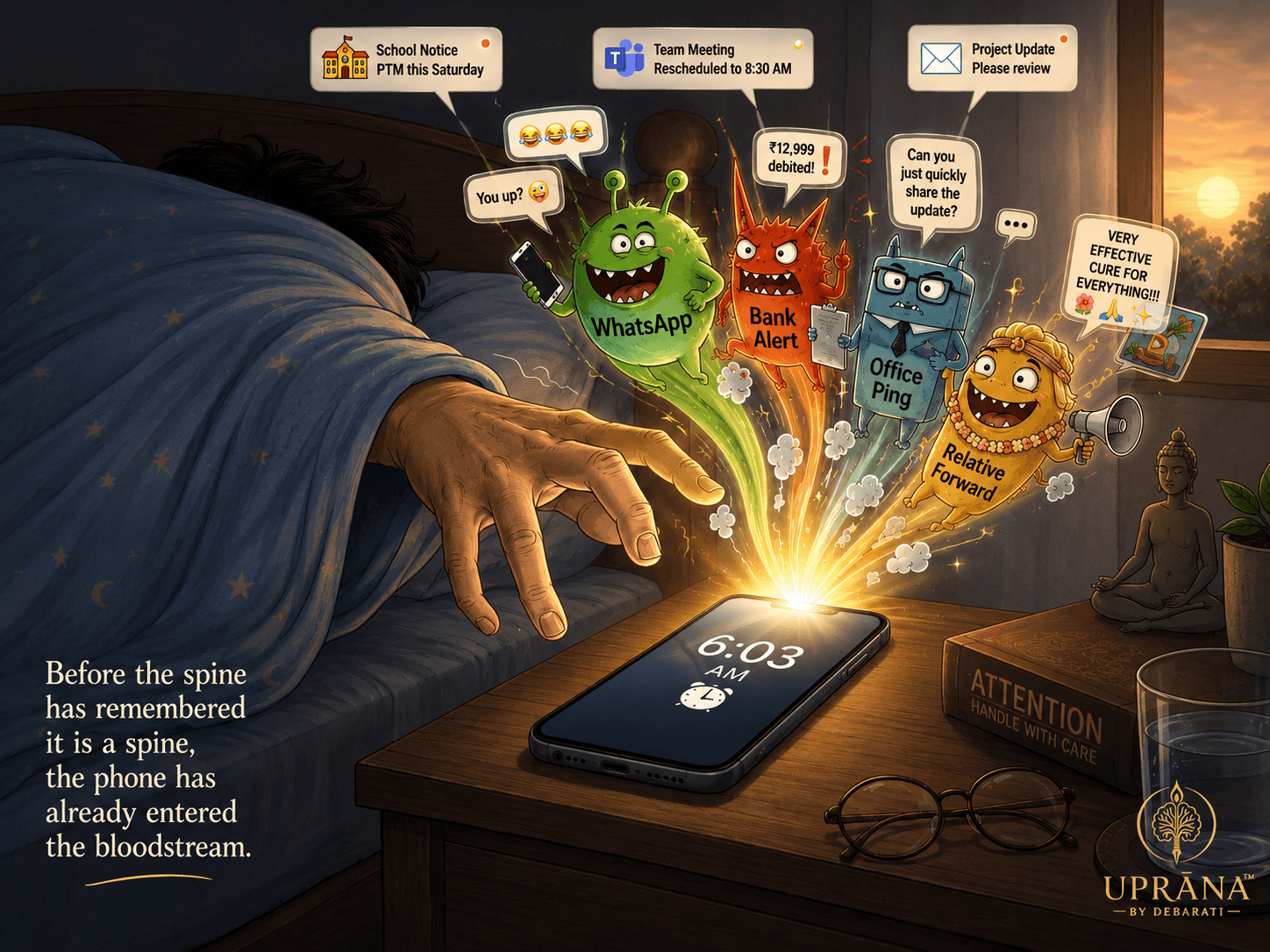
Why modern exhaustion is often not tiredness, but attention loss
# Gooood Morningggg! Today Is a New Day!
“A fresh day. A holy day. A day of discipline, warm water, clean thoughts, maybe even stretching.”
At 6:03 in the morning, a perfectly decent human being wakes up with noble intentions. Today will be different. Today there will be discipline, warm water, perhaps even stretching!
Then the hand reaches for the phone. Not slowly. Not thoughtfully. Not after philosophical consultation with the higher self. It reaches with the speed and loyalty of a trained rescue dog.
Before the spine has remembered that it is a spine, WhatsApp has entered the bloodstream. One school notice. Two office messages. One bank alert. One relative forwarding a medical cure discovered by someone’s neighbour’s yoga teacher’s cousin. One Instagram story from someone who appears to be living inside a permanently sponsored sunset.
By 6:11 AM, nothing major has happened. No war. No deadline. No heartbreak. No tiger in the room. And yet something has already been spent.
Attention.
This is the first theft of the day. The tragic part is that nobody broke into the house. We opened the door ourselves, half-asleep, under a blanket, with one eye still closed and the other one already surrendered to the algorithm.
Then by noon we say, with great sincerity, “I am exhausted.”
Uprāna asks a slightly more uncomfortable question:
Are you tired?
Or are you leaking?
The difference between tiredness and leakage
Tiredness is honest. You worked. You walked. You cooked. You studied. You cared. You created. You carried a child, a meeting, a household, an elderly parent, a manuscript, a salary slip, or a dream through the day.
Tiredness has dignity. A farmer returning from the field is tired. A surgeon after a long procedure is tired. A mother after a feverish night beside her child is tired. A teacher after five classes and forty-seven “Ma’am, one doubt” is tired. A writer after wrestling with one paragraph for three hours is also tired, though outsiders may cruelly say, “But you were just sitting.”
Tiredness comes when energy has been used.
Leakage is different.
Leakage is when your force escapes before it becomes action. You did not use your energy. You lost it.
You lost it in fifteen half-replies. You lost it in the comment you did not need to read. You lost it in the argument you replayed eight times in your head, though the other person had already eaten lunch, watched a reel, and emotionally moved to another continent.
You lost it in comparing your ordinary Tuesday with someone’s carefully filtered Bali breakfast. You lost it in opening ten mental tabs and closing none.
This is what Uprāna calls an Attention Leak.
An Attention Leak is any invisible exit through which your inner force escapes before it can become clear, dignified, directed action. It is not always dramatic. It can be almost embarrassingly ordinary.
It can look like checking the phone while eating. Refreshing email without purpose. Mentally drafting a reply that you never send. Starting work, then “quickly” checking one notification, which behaves like a trapdoor.
It can look like reading about productivity instead of doing the one task that would actually save you. Opening the fridge when the hunger is not in the stomach but in the nervous system. Saying “I am fine” while your whole face has resigned from cooperation.
Modern life has made leakage look normal. In fact, it has made leakage look busy.
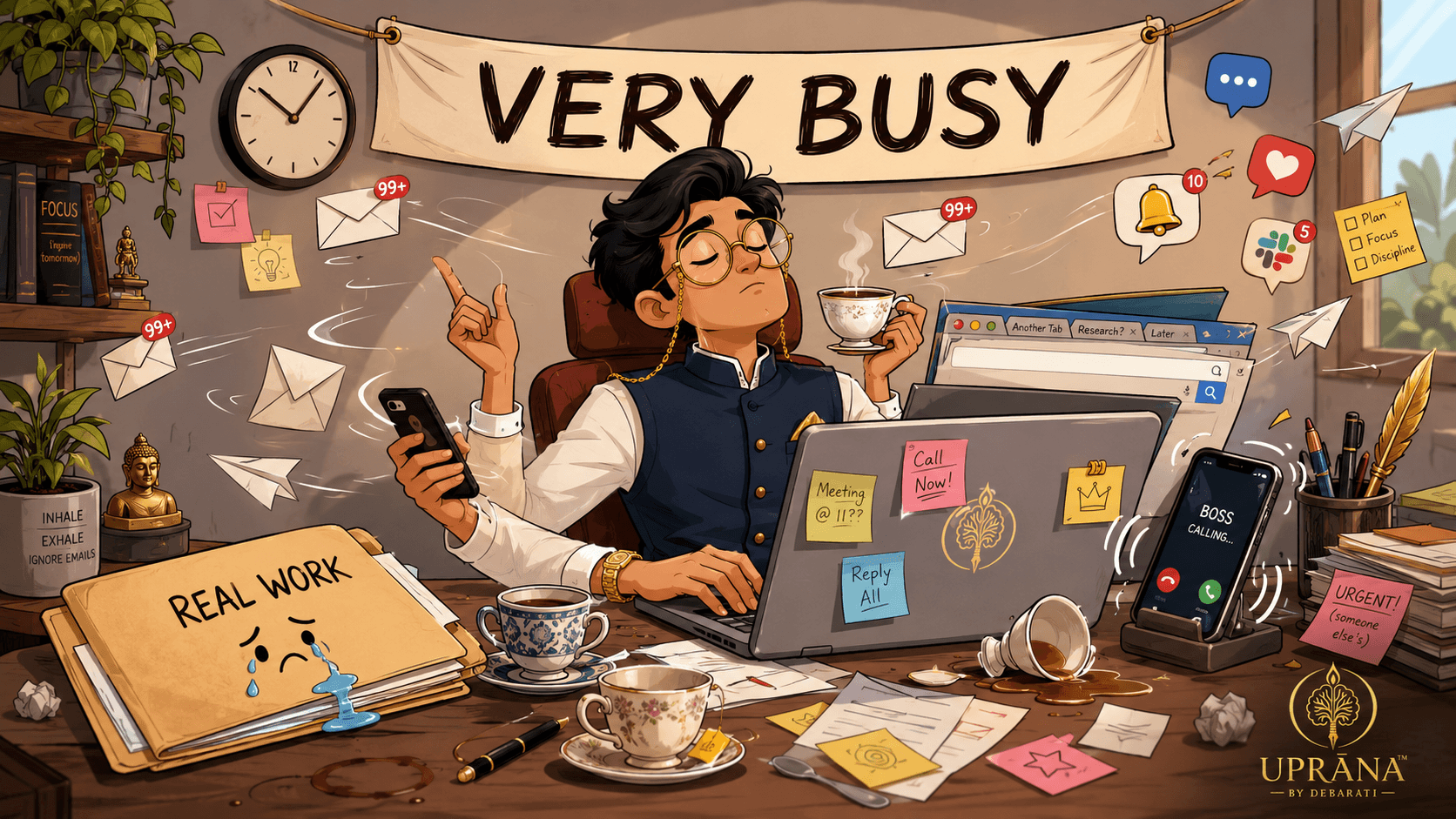
A person can be busy all day and still not be directed. This is one of the great tragedies of the algorithm-driven age.
Busy is external movement. Directed is internal command.
You may answer thirty messages, attend three calls, forward four documents, check seven apps, make two lists, and still end the day with the haunted feeling that the real work remained untouched.
That feeling has a name in Uprāna:
Scattered Force.
Scattered Force is not laziness. It is energy without containment.
Think of water. In a river, water moves with direction. It can nourish fields, turn turbines, carry boats, shape civilizations. On a cracked floor, the same water becomes a mess.
Most people do not have less water. They have too many cracks.
A student says, “I studied the whole day.” But the whole day means forty minutes of actual study, seven snack breaks, one existential crisis, three YouTube explanations of the same chapter, two motivational videos, and a sudden investigation into whether toppers use blue pens or black pens.
A professional says, “I worked all day.” But the day was eaten by notification grazing, inbox grazing, meeting grazing, and the sacred corporate ritual of sending “Noted” with no inner conviction.
A homemaker says, “I didn’t do anything today.” But she has answered twenty questions, managed five emotional climates, remembered the gas cylinder, packed the tiffin, found the missing sock, negotiated with the domestic help, and carried the invisible project management system of an entire household in her head.
The problem is not that modern people are doing nothing. The problem is that much of their energy is leaking through micro-demands before it can gather into meaningful force.
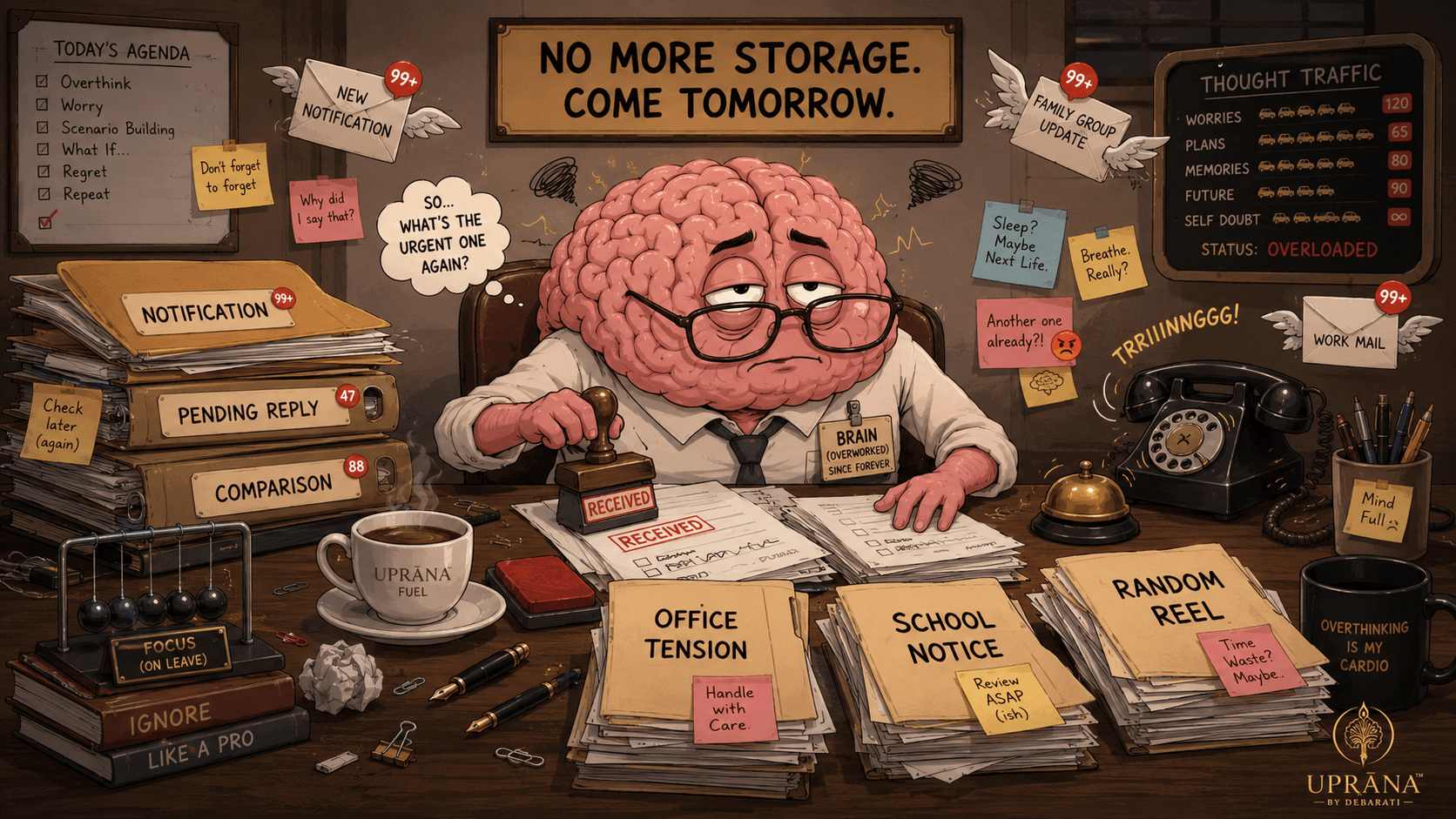
We treat the mind as if it has infinite storage. It does not.
The brain has to filter, select, prioritise, regulate, remember, inhibit, plan, and respond. This is not a small job. Even a half-finished thought takes space. Even an emotional interruption leaves residue.
You may close the app, but the nervous system often keeps the tab open. That one irritating message from morning may continue running silently behind your polite face. The meeting is going on, but inside, one part of you is still writing a savage reply that you will never send because civilization must survive.
This is Cognitive Drain.
Cognitive Drain happens when unfinished inputs continue consuming mental energy after the event is over. The brain does not behave like a neat office clerk who stamps “finished” on every thought. It behaves more like an overworked browser with twenty-seven tabs open, three of them playing music from unknown locations.
And then we wonder why focus feels impossible.
Focus is not missing. It is buried under residue.
There is a scientific way to understand this. Researchers often speak of cognitive load, attentional switching, stress arousal, and executive function. In ordinary language, this means the brain has a limited budget for deep attention. Every switch costs something. Every unfinished emotional thread takes background processing. Every small interruption behaves like a tiny tax.
Individually, these taxes look harmless. One notification. One message. One glance. One comparison. One tiny irritation. One “just two minutes.”
But the nervous system is not fooled by the word “tiny.”
Drops become dampness. Dampness becomes mould. Mould becomes the mysterious smell in the room of the mind.
This is not only a poetic complaint from people who miss the old days when landlines rang like respectable citizens. The data is also muttering the same thing.
A major global digital report estimates that adult internet users now spend more than six and a half hours online each day.
Six and a half hours.
That is nearly a full-time job, only without salary, promotion, provident fund, or the dignity of a lunch break.
The same digital ecosystem keeps expanding into every corner of daily life. In India, internet and social media adoption is not a small urban habit anymore. It is becoming part of the national nervous system.
And globally, emotional health surveys keep showing high levels of worry and stress. A large share of adults report feeling worried or stressed on the previous day.
Not once in childhood. Not during a war. Not after reading one electricity bill.
The previous day.
So when someone says, “Everyone seems a little exhausted now,” they are not being dramatic. The world is emotionally overheated.
And yet we continue to behave as if the solution is one more app, one more hack, one more planner, one more motivational quote with a mountain behind it.
The mountain is innocent. The quote is not enough.
There is a popular claim that humans now have an attention span shorter than a goldfish.
This is unfair.
First, to humans. Second, to goldfish, who have never opened LinkedIn at midnight to compare career trajectories.
The truth is more interesting. Attention is not simply “shrinking” like a cheap sweater after a bad wash. Our basic human capacity for attention is not gone. But our environment has become hostile to sustained attention.
Research on screen behaviour has found that people often switch attention very quickly on digital devices. One well-known attention researcher has reported an average screen-attention span of under a minute in recent years.
This does not mean the human soul has become a defective goldfish. It means the modern attention environment has become aggressively fragmented.
We are not unable to focus. We are being trained not to stay.
That is an important distinction.
Uprāna does not begin by saying, “You are broken.” It says: your attention ecology is polluted, your nervous system is over-addressed, your inner architecture needs repair.
This is where the body enters.
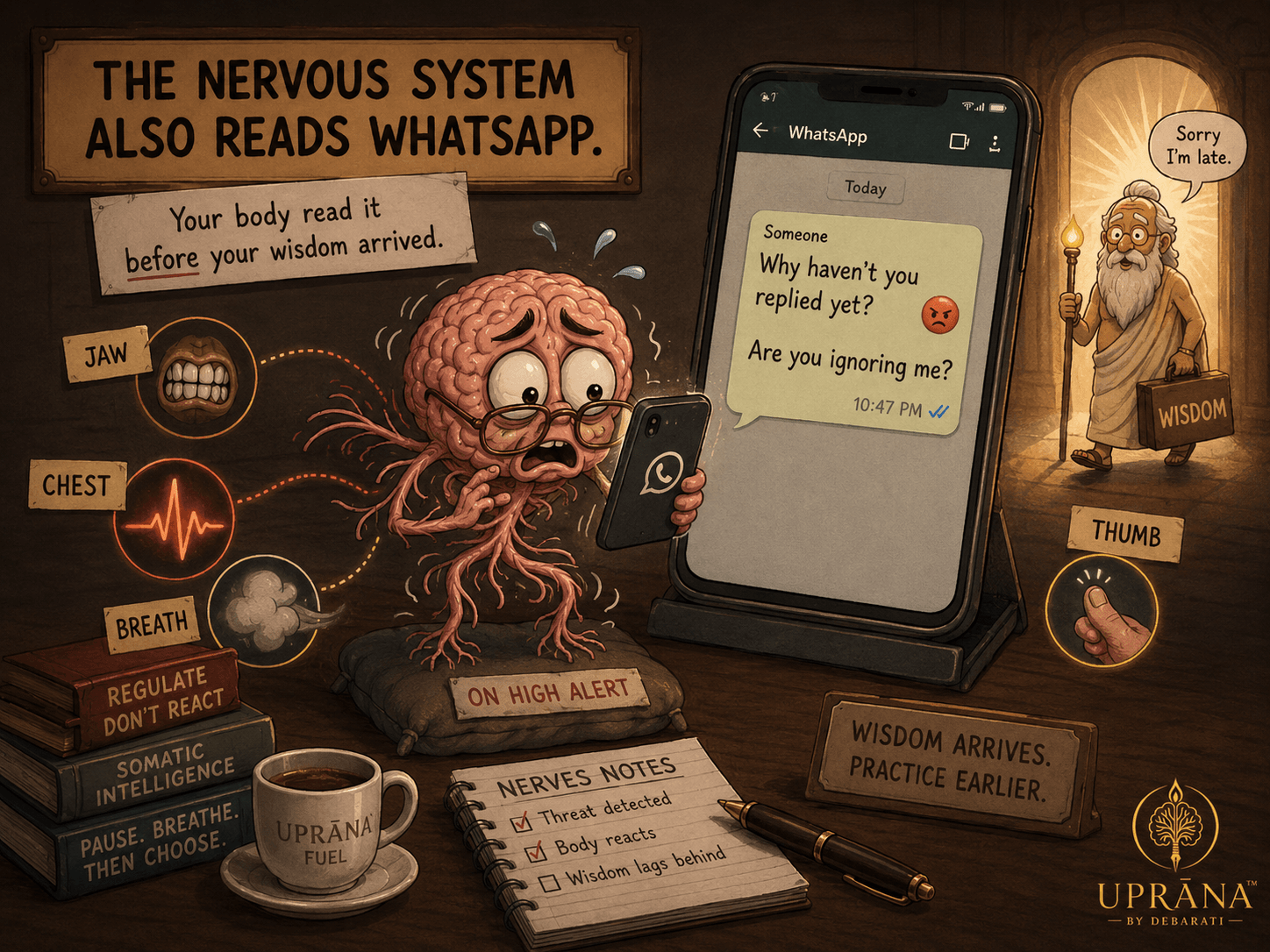
A notification is not just information. Sometimes it becomes a bodily event.
The chest tightens. The breath shortens. The jaw hardens. The thumb begins its little angry dance on the keyboard. The body prepares for a battle that may involve only one blue tick.
This is not poetic exaggeration. Emotional triggers can shift the body into arousal. The stress response does not wait for your philosophical approval. It begins before your higher wisdom has put on its shoes.
That is why we often react first and understand later.
Uprāna calls this Nervous-System Spill.
A Nervous-System Spill happens when an emotion crosses its proper boundary and floods speech, posture, breath, decision, and behaviour.
You meant to answer calmly. But your nervous system had already taken the microphone.
It is the body that often writes the first draft of anger. The mind edits later, usually with regret.
That is why advice like “Don’t overreact” is often useless. It is like telling a boiling kettle to “be mature.” The kettle needs heat regulation, not moral lectures.
Uprāna is interested in that regulation. Not suppression. Not fake peace. Not spiritual acting. Regulation.
The body must be included in wisdom, otherwise wisdom remains a quotation.
Most advice tells us what to do. Wake up early. Be mindful. Eat clean. Stop scrolling. Control anger. Focus deeply. Stay positive.
Excellent.
But modern people already know many of these things. They have saved the reels. They have bought the notebooks. They have liked the quotes. They have attended the webinars. They have even written “new life from Monday” several times with admirable optimism.
The problem is not always knowledge. The problem is command.
Can you hold your attention when the algorithm wants it? Can you hold your speech when anger sharpens it? Can you hold your posture when despair bends it? Can you hold your breath long enough to choose a response? Can you hold your morning before the world enters?
This capacity is what Uprāna calls Inner Command.
Inner Command is the ability to remain internally governed when the world tries to scatter you. It is not rigidity. It is not suppression. It is not becoming a Himalayan sage who never gets irritated because nobody has asked him to locate a missing school sock at 6:45 AM.
Inner Command is practical. It is the pause before reply. The completed task before distraction. The breath before the sentence. The meal without scrolling. The morning not donated to strangers. The anger seen before it becomes theatre.
It is the difference between: “I felt it, so I became it,” and “I felt it, so I observed it, contained it, and chose.”
That small difference is civilization.
Uprāna begins with a simple architecture:
Leak. Lock. Direct.
First, identify the Leak. Where is your attention escaping? Where is your energy draining? Where is your dignity getting punctured? Where is your mind repeatedly hijacked?
Do not answer beautifully. Answer honestly.
The phone? The fridge? The inbox? The person who still has emotional tenancy in your head without paying rent? The need to be liked? The habit of saying yes? The addiction to crisis? The tiny pleasure of outrage? The romantic relationship with delay?
The first act of power is not control. It is diagnosis.
Then build the Lock.
A Lock is not punishment. A Lock is conscious containment.
It may be twenty minutes of phone-free morning. It may be one breath before answering. It may be writing the task before opening the laptop. It may be keeping the body still when the mind wants drama. It may be refusing to turn every emotion into an announcement.
The Lock is where the system stops spilling. Not forever. Just long enough for choice to return.
Then Direct the force.
Attention must go somewhere. If you do not direct it, the world will.
This is the secret nobody tells us. Your attention will not remain unemployed. Either you employ it consciously, or the algorithm recruits it.
Tomorrow morning, do not try to transform your entire life. That is how people fail with great enthusiasm.
Try only this.
When you wake up, do not touch the phone for the first sixty seconds. Just sixty.
This is not extreme asceticism. Nobody is asking you to renounce civilisation, shave your head, and live on boiled bottle gourd. Just sixty seconds.
Sit up. Feel the spine. Notice the breath. Ask one question:
Where is my first attention going today?
That question is already a revolution.
Because the first attention of the day is not a small thing. It is the first offering of your consciousness.
Do you want to offer it to a notification? To someone’s vacation? To a forwarded panic? To a stranger’s opinion? To a political shouting match? To an advertisement that has understood your insecurity with frightening accuracy?
Or to your own life?
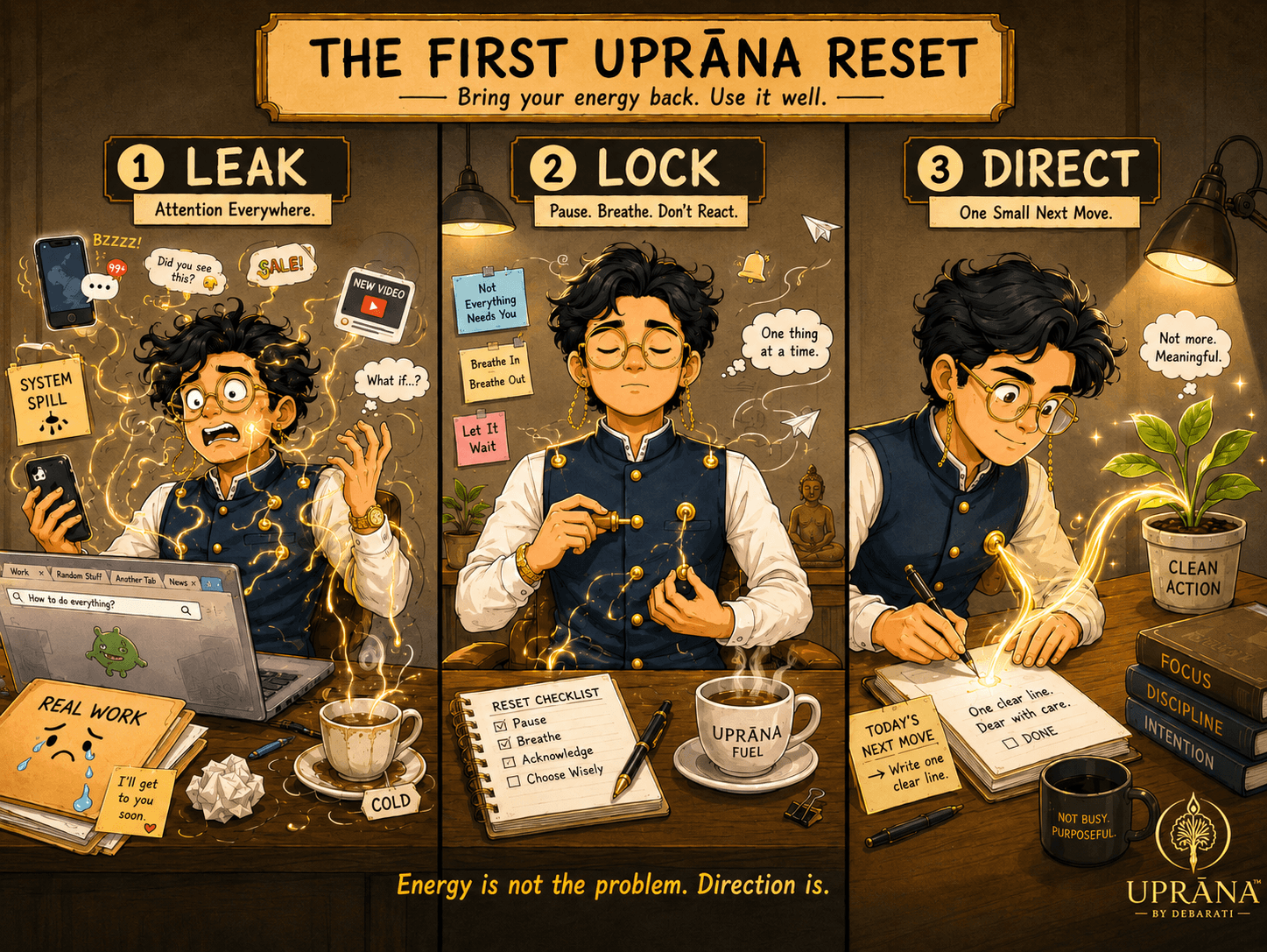
When you feel scattered, try the 60-Second Inner Reset.
For 20 seconds, notice the Leak. Ask: what is pulling me right now?
Not morally. Clinically. Like a doctor checking pulse. Like a mechanic locating the sound. Like a mother knowing from the silence that the child has done something suspicious.
For 20 seconds, build the Lock. Sit still. Relax the jaw. Lengthen the spine. Slow the breath. Do not react.
This is not weakness. This is system recovery.
For 20 seconds, Direct. Ask: what is the next clean action?
Not the perfect action. Not the heroic action. The clean one.
Drink water. Write the email. Close the app. Begin the paragraph. Apologise. Stop typing. Eat without the screen. Walk for five minutes. Return to the task.
This is not magic. It is command practice.
And command grows by repetition.
This is important.
Uprāna does not begin by insulting the human being.
You are not weak because you are distracted. You are living in an age where distraction has been industrialised.
You are not shallow because your mind jumps. You are living in a world that has trained the mind to jump.
You are not broken because you feel overwhelmed. You may simply be open in too many places.
A palace with all doors open is not generous. It is unsafe.
A mind with all doors open is not modern. It is leaking.
There is sweetness in this diagnosis.
Because if you are leaking, then the problem is not that you are hopeless. The problem is architectural.
A leak can be noticed. A crack can be repaired. A door can be closed. A force can be gathered. A system can be trained.
Uprāna begins from that hope.
Not the loud hope of motivational posters. The quiet hope of a person who finally understands why they have felt so scattered, and realises:
Maybe I was not failing.
Maybe I was leaking.
So tonight, before sleeping, do not ask only:
What did I achieve today?
Ask: Where did I leak today? Where did my attention escape? Where did my body react before I chose? Where did I give my first energy to noise? Where did I confuse activity with direction?
Where did I allow one message to occupy the emotional square footage of an entire room? Where did I hold myself with dignity? Where did I return to command?
This is where Uprāna begins!
Not with incense. Not with slogans. Not with the performance of peace. Not with wearing white and secretly wanting to slap someone. Not with pretending that irritation is beneath you while your eyebrow says otherwise.
It begins in the tiny, brave moment when a human being notices:
My force is escaping.
And then decides:
Let me bring it back.
You are not lost.
You are leaking.
And what leaks can be noticed. What is noticed can be contained. What is contained can be directed.
That is the first door of Uprāna.
Enter slowly.
Do not make an announcement. Do not buy a new notebook yet. Do not design a ten-year transformation plan at 1:17 AM.
Just begin tomorrow morning.
Sixty seconds.
Phone outside. Spine awake. Breath present. Attention returned.
The world can wait.
For once, let your own life enter first!

Author bio details are hosted inside our dynamic Strapi CMS database.
Join our private network of 12,000+ modern performers. Receive weekly frameworks, micro-resets, and somatic insights direct to your inbox.

From the 6:03 AM phone grab to the 11:47 PM “just one reel” tragedy!...
READ ARTICLE →